
About This Book:
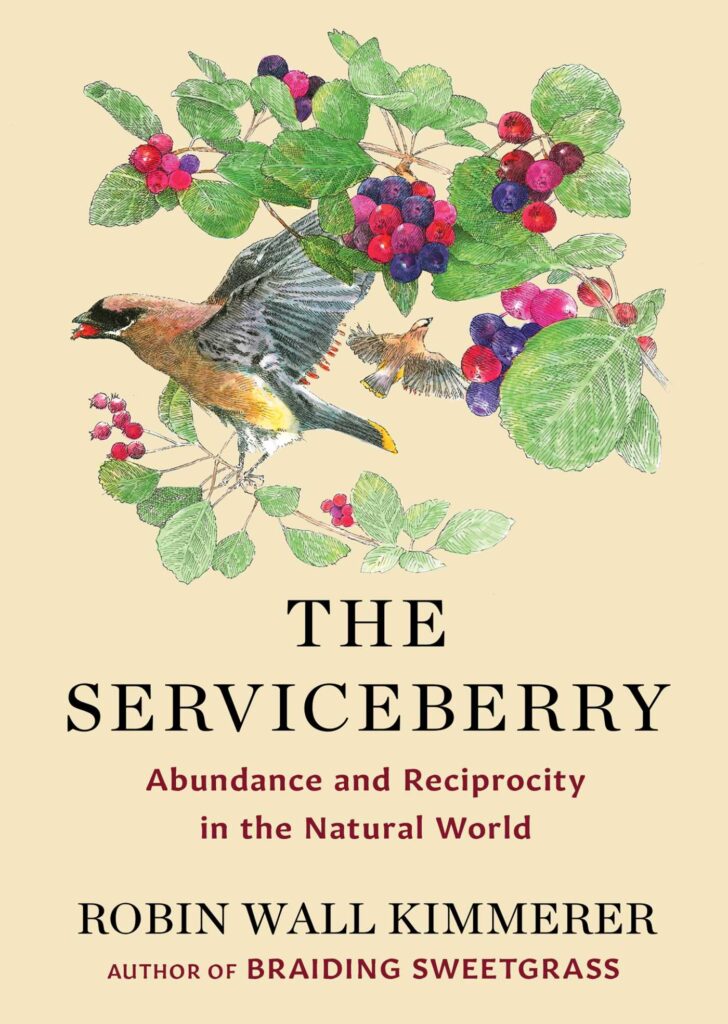
From the #1 New York Times bestselling author of Braiding Sweetgrass, a bold and inspiring vision for how to orient our lives around gratitude, reciprocity, and community, based on the lessons of the natural world.
As Indigenous scientist and author of Braiding Sweetgrass Robin Wall Kimmerer harvests serviceberries alongside the birds, she considers the ethic of reciprocity that lies at the heart of the gift economy. How, she asks, can we learn from Indigenous wisdom and the plant world to reimagine what we value most?
Our economy is rooted in scarcity, competition, and the hoarding of resources, and we have surrendered our values to a system that actively harms what we love. Meanwhile, the serviceberry’s relationship with the natural world is an embodiment of reciprocity, interconnectedness, and gratitude. The tree distributes its wealth—its abundance of sweet, juicy berries—to meet the needs of its natural community. And this distribution insures its own survival. As Kimmerer explains, “Serviceberries show us another model, one based upon reciprocity, where wealth comes from the quality of your relationships, not from the illusion of self-sufficiency.”
As Elizabeth Gilbert writes, Robin Wall Kimmerer is “a great teacher, and her words are a hymn of love to the world.” The Serviceberry is an antidote to the broken relationships and misguided goals of our times, and a reminder that “hoarding won’t save us, all flourishing is mutual.”
My Thoughts After Reading:
Even as a fiction reader, I devoured this nonfiction read in two sittings. The Serviceberry is incredibly well written – full of interesting facts, heartwarming stories and approachable alternatives. While this book can be read at any time of year, it feels timely to read during “gift giving” season.
Kimmerer introduces us to a gift economy where there is value in reciprocity and relationships nourish the well-being of a whole community. I was worried a critic of our scarcity-based economy might come off as “preachy” or evoke feelings of shame/guilt. I felt neither of these while reading. In fact, I am inspired to find ways to operate within a gift economy in my own life – something that, if you read this book, you’ll discover is attainable for each of us.
She argues that gift economies are everywhere. It is our job to pay attention and to name them as such. For example, Kimmerer writes “Public libraries seem to me a powerful example of the way that gift economies can coexist with market economies, at a larger scale.” As if we needed another reason to love our local library.
This short, powerful book should be on everyone’s to-be-read list!
– Michelle