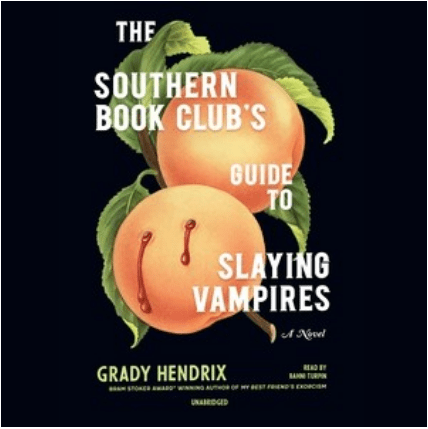
“The Southern Book Club’s Guide to Slaying Vampires” Grady Hendrix
Summary:
“Patricia Campbell’s life has never felt smaller. Her husband is a workaholic, her teenage kids have their own lives, her senile mother-in-law needs constant care, and she’s always a step behind on her endless to-do list. The only thing keeping her sane is her book club, a close-knit group of Charleston women united by their love of true crime. At these meetings they’re as likely to talk about the Manson family as they are about their own families.
One evening after book club, Patricia is viciously attacked by an elderly neighbor, bringing the neighbor’s handsome nephew, James Harris, into her life. James is well traveled and well read, and he makes Patricia feel things she hasn’t felt in years. But when children on the other side of town go missing, their deaths written off by local police, Patricia has reason to believe James Harris is more of a Bundy than a Brad Pitt. The real problem? James is a monster of a different kind—and Patricia has already invited him in.
Little by little, James will insinuate himself into Patricia’s life and try to take everything she took for granted—including the book club—but she won’t surrender without a fight in this blood-soaked tale of neighborly kindness gone wrong.”
The Southern Book Clubs Guide to Slaying Vampires by Grady Hendrix is simultaneously everything and nothing that its title suggests. Upon reading the moniker, one might get the impression that this is a comedic satire. It is. And it isn’t. There are funny moments and there are satirical moments. Sometimes the two even intersect. But Hendrix does so much more. The satire can be funny, but it can also be scathing. The humor can be both amusing and frustrating, and it is counterbalanced by the very fact that this is still a horror novel. It may not be just a horror novel, but it is horrific when it needs to be. Hendrix does a fantastic job of blending all of these elements in a way that can critique the culture and time period addressed without feeling that he is writing with an agenda. He can make you laugh out loud without cheapening the visceral moments. None of these seemingly contrasting constituent parts are at odds. They don’t conflict. Nothing feels out of place as Hendrix transitions effortlessly between modes.
Thoughts:
Hendrix accomplishes quite a significant feat in a book that is socially conscious, often humorous, and frequently terrifying—he invokes a range of emotion in the reader. He takes characters that could easily be dismissed as stereotypes and caricatures and turns them into fully-formed individuals. Readers will find themselves increasingly frustrated by Patricia’s woes and will want to fight for her and those she holds dear, not only against the evil in which she alone believes but against the social and familial mistreatment she must endure as the only seemingly sane person in a collection of characters that have written her off as mad.
More works by Grady Hendrix, available at Town Hall Library!