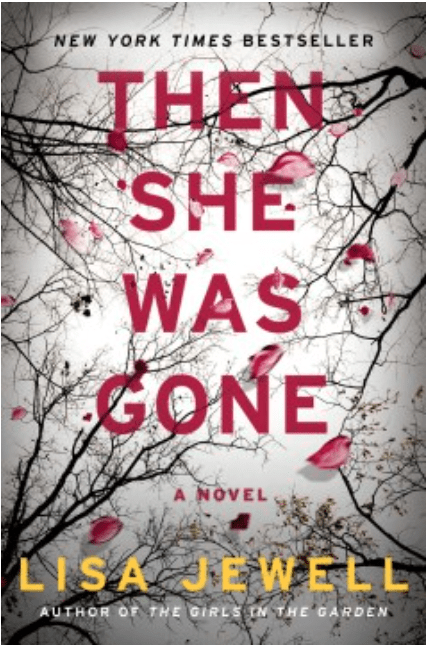
“Ellie Mack was the perfect daughter. She was fifteen, the youngest of three. Beloved by her parents, friends, and teachers, and half of a teenaged golden couple. Ellie was days away from an idyllic post-exams summer vacation, with her whole life ahead of her.
And then she was gone.
Now, her mother Laurel Mack is trying to put her life back together. It’s been ten years since her daughter disappeared, seven years since her marriage ended, and only months since the last clue in Ellie’s case was unearthed. So when she meets an unexpectedly charming man in a café, no one is more surprised than Laurel at how quickly their flirtation develops into something deeper. Before she knows it, she’s meeting Floyd’s daughters—and his youngest, Poppy, takes Laurel’s breath away.
Because looking at Poppy is like looking at Ellie. And now, the unanswered questions she’s tried so hard to put to rest begin to haunt Laurel anew. Where did Ellie go? Did she really run away from home, as the police have long suspected, or was there a more sinister reason for her disappearance? Who is Floyd, really? And why does his daughter remind Laurel so viscerally of her own missing girl?”
It would be inaccurate to say that Lisa Jewell’s Then She Was Gone starts in the middle. The truth is, the story starts surprisingly close to its conclusion. Ellie Mack has disappeared but not recently. She’s been gone for ten years already by the time the reader joins the fray. Following her mother, Laurel, the reader gets a picture of life both before and after Ellie’s disappearance. The timeline shifts from past to present and back again throughout the story, offering pieces that begin to connect in the reader’s mind. The narrative purpose of these pieces demands no heavy lifting on the part of the reader, though. The structure is more akin to a simple 100 piece jigsaw puzzle, where the placement of each object quickly becomes clear, than it is to a 1,000 piece monstrosity full of vibrant and overlapping colors that require dedicated determination on the part of the solver. Jewell’s book is not intended to be such an arduous effort. It is a story designed to allow a picture of events to unfold before the reader without relying on clever twists or unexpected surprises. It is simple and complete and devoid of the unforeseen.
Thoughts:
As noted above, Lisa Jewell’s Then She Was Gone is not designed to surprise you. It is not a book where you read the last page of some late chapter and say out loud, “Well, I didn’t see that coming.” It’s not that type of mystery. The details are presented in their own time and—as previously noted—create a clear path to the finish. I, personally, like a fair dose of the unpredictable in the mysteries I read, but to each their own. Where I really see a hiccup in Jewell’s methods begins about nearly halfway into the book. With the start of Part Three, there is a surprising shift in narrative perspective, one that is echoed even more jarringly toward the end of the book. The sudden shift in narration after over a hundred and fifty pages of prose feels a bit awkward. It almost reads as though Jewell started the book with an idea and lost her handle on how to bring it all together, so she chose to incorporate these not-so-subtle shifts in the presentation of the story to provide a purely expositional explanation of events. The book is not dissatisfying for those insistent on concise explanations and the variety of closure that does not abide loose ends. It is capably written and the premise is intriguing. I only wish the story had unfolded with a little more show and a little less tell.