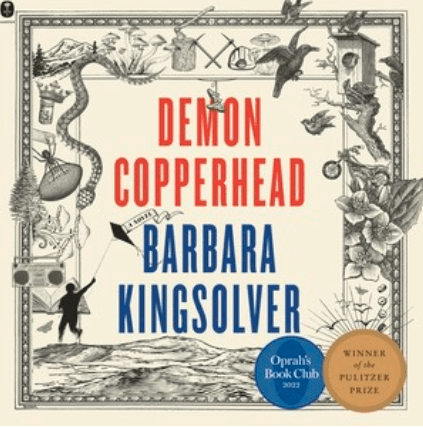
“Set in the mountains of southern Appalachia, Demon Copperhead is the story of a boy born to a teenaged single mother in a single-wide trailer, with no assets beyond his dead father’s good looks and copper-colored hair, a caustic wit, and a fierce talent for survival. Relayed in his own unsparing voice, Demon braves the modern perils of foster care, child labor, derelict schools, athletic success, addiction, disastrous loves, and crushing losses. Through all of it, he reckons with his own invisibility in a popular culture where even the superheroes have abandoned rural people in favor of cities.
Many generations ago, Charles Dickens wrote David Copperfield from his experience as a survivor of institutional poverty and its damages to children in his society. Those problems have yet to be solved in ours. Dickens is not a prerequisite for readers of this novel, but he provided its inspiration. In transposing a Victorian epic novel to the contemporary American South, Barbara Kingsolver enlists Dickens’ anger and compassion, and above all, his faith in the transformative powers of a good story. Demon Copperhead speaks for a new generation of lost boys, and all those born into beautiful, cursed places they can’t imagine leaving behind.”
Kingsolver draws the reader into a part of America with which they may not be familiar, one they may have already—consciously or unconsciously—filed away under some broad, possibly unfair and unkind, stereotype. She makes this setting a character, well rounded and three dimensional, without the snide dismissal so often cast on the quieter corners of the country. She draws the reader into the heart of Appalachia: a real place, populated with real people and their all too real strife. Kingsolver does this without mercy, opting not to wade readers gently through the shallows but to drop them straight into the rip current, where they are left to struggle helplessly against its pull. Floundering amidst the crashing waves of poverty, neglect, and addiction, the reader follows Demon through each phase of his life, be it yet another setback or a momentary triumph, until the stakes feel as important to the reader as they are to the protagonist himself. Demon Copperhead may be a work of fiction, but Kingsolver’s use of historical information—from the documented oppression and exploitation of coal workers to the opioid crisis and its impact on rural areas like Demon’s beloved Lee County—paints a picture as honest and true as any plucked from real life.
Thoughts:
Having not previously read the Dickens story to which Kingsolver’s Pulitzer Prize winning novel aspires, I cannot speak in direct comparisons. I can, however, say that Demon Copperhead is deserving of the praise it has received and each and every one of the sixty-four weeks it has spent on the New York Times’s Bestseller List. It is an utterly human look at a life moving through utterly dehumanizing obstacles and emerging on the other side a product of these experiences—for better or worse.
Check out these other reads from Barbara Kingsolver, including the Pulitzer Prize nominated The Poisonwood Bible, available at Town Hall Library.